
 Anglais
 français
 espagnol
 russe
russe coréen
 japonais


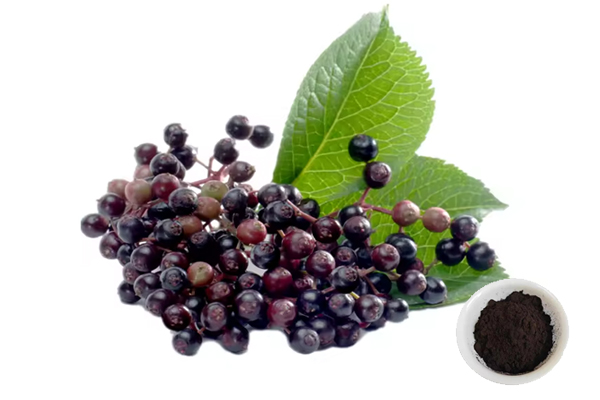
Elderberry Fruit Extract 15% Anthocyanins
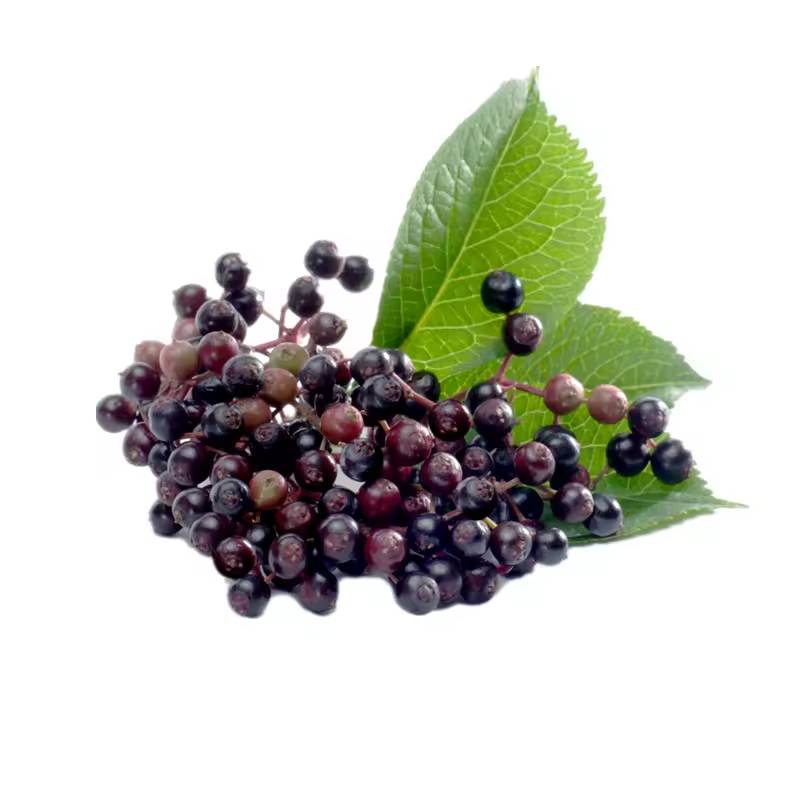
Source: Mature berries of Sambucus nigra L.
Assay: ≥ 15.0% Total Anthocyanins
Testing Method: HPLC/HPLC
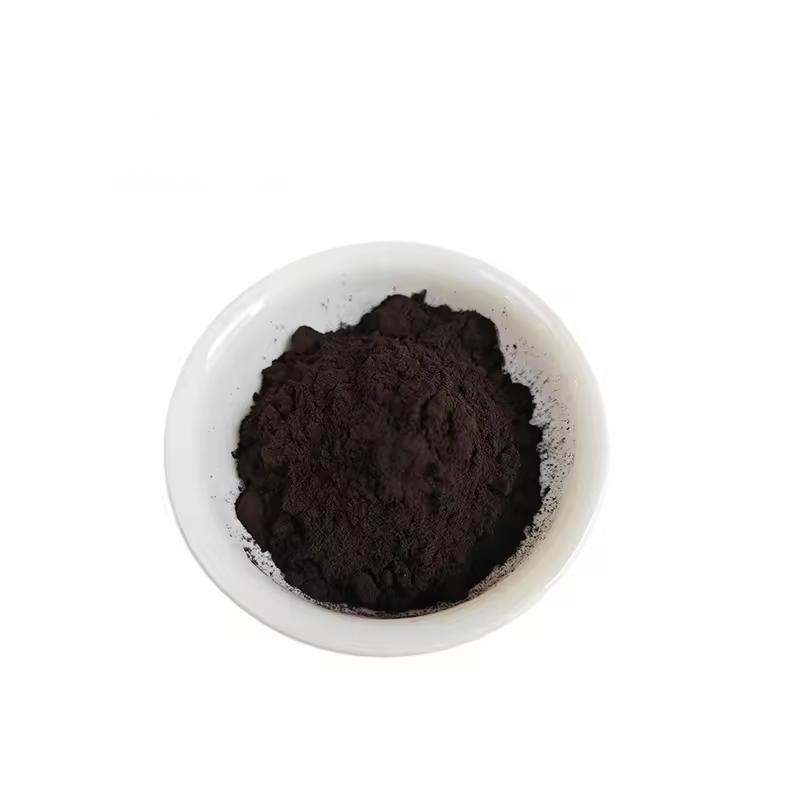
Appearance: Fine dark violet to deep purple-red uniform powder
Mesh Size: 100% through 80 Mesh
Bulk Density: 0.40 g/mL – 0.55 g/mL
Tapped Density: 0.55 g/mL – 0.70 g/mL
Loss on Drying: ≤ 5.0%
Certificates: BRCGS, IFS, Organic (USDA/EU), Halal, Kosher
Sample: 10-50g Free Sample Available for R&D
- Description Description
- Fiche technique
-
What | USP Compliant | Non-GMO | Clean Labelis Extrait de Fruit de sureau?
What is Elderberry Fruit Extract?
Elderberry Fruit Extract is a free-flowing botanical ingredient derived from the mature berries of Sambucus nigra L. and standardized via HPLC/HPLC to contain a minimum of 15.0% total anthocyanins (calculated as cyanidin-3-glucoside). The raw material is delivered as a fine dark violet to deep purple-red powder milled to an 80-mesh target particle profile with an untapped bulk density controlled between 0.40 g/mL and 0.55 g/mL for optimized commercial handling.
The manufacturing sequence employs exclusively food-grade ethanol and water, operating under high-vacuum low-temperature evaporation to restrict total residual solvents to ≤ 5,000 ppm via a hexane-free process. Strict closed-loop thermal processing ensures total ash remains below 5.0% and chemical stability is maintained across consecutive production lots without employing gamma irradiation or ethylene oxide (ETO) sterilization.
Engineered for high-output dietary supplements and compounding matrices, this technical ingredient provides consistent flowability that eliminates mechanical die-sticking or hopper bridging on automated encapsulation and tableting lines. The batch-to-batch physicochemical consistency ensures predictable blending kinetics and prevents localized component segregation or color ringing in dry-powder formula mixing and pectin gummy matrices.
spécification
Nom du produit
Elderberry Fruit Extract Powder
Nom Latin
Sambucus nigra L.
Source:
Mature berries of Sambucus nigra L.
Ingrédients actifs
Total Anthocyanins
analyse
≥ 15.0% Total Anthocyanins
Méthode d’essai
HPLC
apparence
Fine dark violet to deep purple-red uniform powder
Mesh Size 100% through 80 Mesh (≤ 177 μm) Bulk Density 0.40 g/mL – 0.55 g/mL (USP <616> Method I) Tapped Density 0.55 g/mL – 0.70 g/mL (USP <616> Method I) Loss on Drying ≤ 5.0% (USP <731> at 105°C) Total Ash ≤ 5.0% (USP <561> / EP Certified) Residual Solvents Ethanol ≤ 5,000 ppm; Hexane ≤ 290 ppm (Meets USP <467> / ICH Q3C limits) Heavy Metals Pb ≤ 1.0 ppm; As ≤ 1.0 ppm; Cd ≤ 0.5 ppm; Hg ≤ 0.1 ppm (ICP-MS, USP <233> / Prop 65 Compliant) La microbiologie TAMC ≤ 1,000 cfu/g; TYMC ≤ 100 cfu/g; E. coli / Salmonella: Absent (USP <61/62> / Non-Irradiated) Regulatory Status EP Certified | USP Compliant | Non-GMO | Clean Label Vous cherchez un devis?Contactez nousRequest a Custom QuoteQuality & Compliance
Multi-Tier International Site Certifications: Operating within an FDA Facility Registration hub audited under the British Retail Consortium Global Standard (BRCGS Grade A Status) and International Featured Standards (IFS Higher Level Certification) to satisfy global cGMP validation criteria.
Identity Preservation & Dietary Access: Maintained under fully validated segregation matrices to guarantee universal compliance with international Halal, Kosher, USDA Organic (7 CFR Part 205), and EU Organic regulatory food-safety verification standards.
Elemental Heavy Metal Contaminant Control: Every batch undergoes ICP-MS instrumental screening under USP <233> to enforce absolute compliance with California Proposition 65 MADLs, restricting Mercury to ≤ 0.1 ppm and Cadmium to ≤ 0.5 ppm.
Compendial Microbiological Release Governance: Pathogen verification complies strictly with USP <61/62> harmonization codes, executing pure physical thermal control to guarantee the complete absence of E. coli and Salmonella without employing chemical fumigation.
Pesticide and Solvent Residual Verification: Validated via automated chromatography to compress chemical residues below strict USP <467> / ICH Q3C thresholds, ensuring 100% compliance with maximum residue ceilings mandated by European Regulation EC No. 396/2005.

Key Advantages
Optimized Particle Kinetic Distribution for High-Velocity Dosing: Micro-milled precision screening guarantees a continuous 100% through 80 mesh target profile, restricting inter-particulate cohesive torque. This structural uniformity eliminates localized wall friction inside pneumatic delivery pathways, maintaining uninterrupted gravity-fed flow rates through automated processing systems.
Interfacial Anti-Adhesion Matrix under Thermal Compaction: The moisture-insulated botanical crystals exhibit high resistance against premature ambient humidity intake, controlling the untapped bulk density between 0.40 g/mL and 0.55 g/mL. This morphology prevents material softening under high-tonnage compaction, eliminating punch-face glazing and mechanical die-sticking during continuous manufacturing.
Verified Multi-Stage Analytical Volatile Purification: Utilizing an advanced hydro-alcoholic countercurrent extraction system restricted to food-grade ethanol and water yields a pristine extract fingerprint. Vacuum-evaporation compression restricts chemical contaminants below strict compendial thresholds (Ethanol ≤ 5,000 ppm; Hexane ≤ 290 ppm), ensuring full compliance with USP <467> and ICH Q3C safety guidelines.
Closed-Loop Thermal Decontamination and Native Protection: A validated physical pasteurization process applies synchronized thermal cycles to satisfy stringent microbiological release limits (TAMC ≤ 1,000 cfu/g). This containment intervention guarantees a 100% Irradiation-Free and Non-ETO status, fully maintaining the structural integrity of delicate active cyanidin-3-glucoside profiles.
Applications
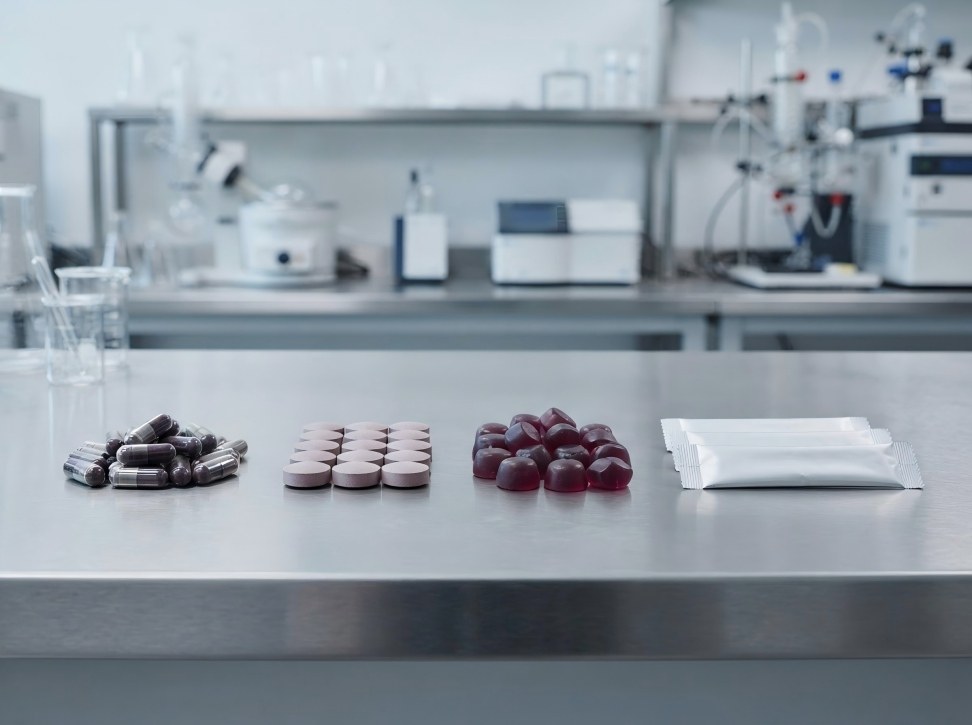
Solid-Dosage Encapsulation Line Matrices (Hard Gelatin & Veggie Capsules): The controlled 0.40 g/mL to 0.55 g/mL untapped bulk density ensures uniform volumetric die-cavity filling on high-output capsule equipment. The 80-mesh target particle profile eliminates component segregation when dry-blended with excipients like microcrystalline cellulose (MCC), preventing localized active-ingredient concentration drifts across extended automated manufacturing cycles.
Compressed Tablet Compounding and Direct Compression (DC) Systems: The hydro-alcoholic countercurrent isolation preserves inherent compactability and tensile strength under typical cleanroom relative humidity environments. The cohesive blending dynamics eliminate mechanical friction bind within tablet press punch-faces, preventing localized die-sticking or edge-chipping during high-tonnage direct compression runs.
Hydrocolloid Fortification Formulations (Nutraceutical Gummies and Confectionery): The deep dark violet to deep purple-red powder disperses predictably into high-solids pectin or gelatin slurries without inducing premature gelling or texture aeration. The heat-insulated active fractions endure standard thermal confectionery pasteurization curves without causing structural tint degradation or localized flavor ring precipitation in final functional gummy matrices.
Premix Powder Sachets and Dry Beverage Blends: The technical matrix maintains highly predictable blending kinetics under standard low-shear mechanical agitation. This structural uniformity prevents pneumatic separation or particle strata settling during industrial hopper transfers, ensuring uniform volumetric dosing into individual stick-packs or multi-dose functional beverage pouches.
Technical FAQ
Q1: What mechanical control parameter prevents cohesive particle separation when blending Elderberry Fruit Extract 15% Anthocyanins into multi-ingredient dry powder drink formulas?
A1: Structural separation is resolved by milling Elderberry Fruit Extract 15% Anthocyanins Powder to an 80-mesh target profile with an untapped bulk density of 0.40 g/mL to 0.55 g/mL. This distribution controls inter-particulate cohesive torque, matching the volumetric blending kinetics of common carrier matrices and ensuring absolute dosage uniformity on continuous stick-pack packaging lines.Q2: How does the manufacturing thermal profile protect the delicate pigment stability of Elderberry Fruit Standardized Extract during high-temperature hydrocolloid confectionery compounding?
A2: Thermal degradation is prevented through clean vacuum-evaporation that stabilizes the active cyanidin-3-glucoside structure. This yields a heat-insulated Elderberry Fruit 15% Anthocyanins Extract that endures standard thermal confectionery pasteurization curves, eliminating localized color ringing and pigment precipitation when deposited into high-solids pectin gummy matrices.Q3: What analytical validation protocol confirms that the water-soluble European Elderberry Extract satisfies European pesticide limits and Class 2 residual solvent tolerances simultaneously?
A3: Every batch of Elderberry Extract 15% Anthocyanins HPLC undergoes dual-tier instrumental verification via GC-HS and ICP-MS. Quantitative chromatography protocols under USP <467> verify a strict Ethanol ≤ 5,000 ppm and Hexane ≤ 290 ppm control ceiling, matching the residual release thresholds required to pass global CDMO vendor qualification audits.B2B Sourcing & Global Supply Capabilities
26-Year Industrial Manufacturing Base: Operating since 2000, Green Spring Technology delivers a stable annual capacity of 250 Metric Tons (MT) for standardized botanical fractions, ensuring unbroken multi-year commercial supply for global dietary supplement brands and CDMO partners.
Flexible Factory-Level MOQ & Free Samples: The facility enforces a flexible commercial Minimum Order Quantity (MOQ) of 1 kg for pilot-scale industrial validation. Qualified corporate R&D entities can request a 10g to 50g free sample for active laboratory evaluation and pre-formulation pilot blending tests.
Standard Packaging Architecture: Cargo is dispatched within heavy-duty, dual-layer food-grade polyethylene internal liners housed inside standard export fiber drums (25kg net weight per drum) to prevent atmospheric moisture ingress and structural degradation during cross-border transit.
Global Warehousing & Rapid Logistics: Primary manufacturing hubs connect to Shanghai and Qingdao maritime ports within 3 to 7 business days. To eliminate international freight lag, a fully stocked European regional warehouse is operational in Paris, France, enabling overland distribution across the EU within 48 to 72 hours.
Customs Clearance & Risk Mitigation: Every lot is delivered alongside a full, audit-ready documentation package containing batch-specific COA, SDS, GMO Statements, Allergen Matrix, and process Flowcharts to accelerate customs clearance and neutralize geopolitical supply chain bottleneck liabilities.
-
Download Data Sheet: COA, TDS, MSDS Please fill in the form below to receive the full technical documents via email.